
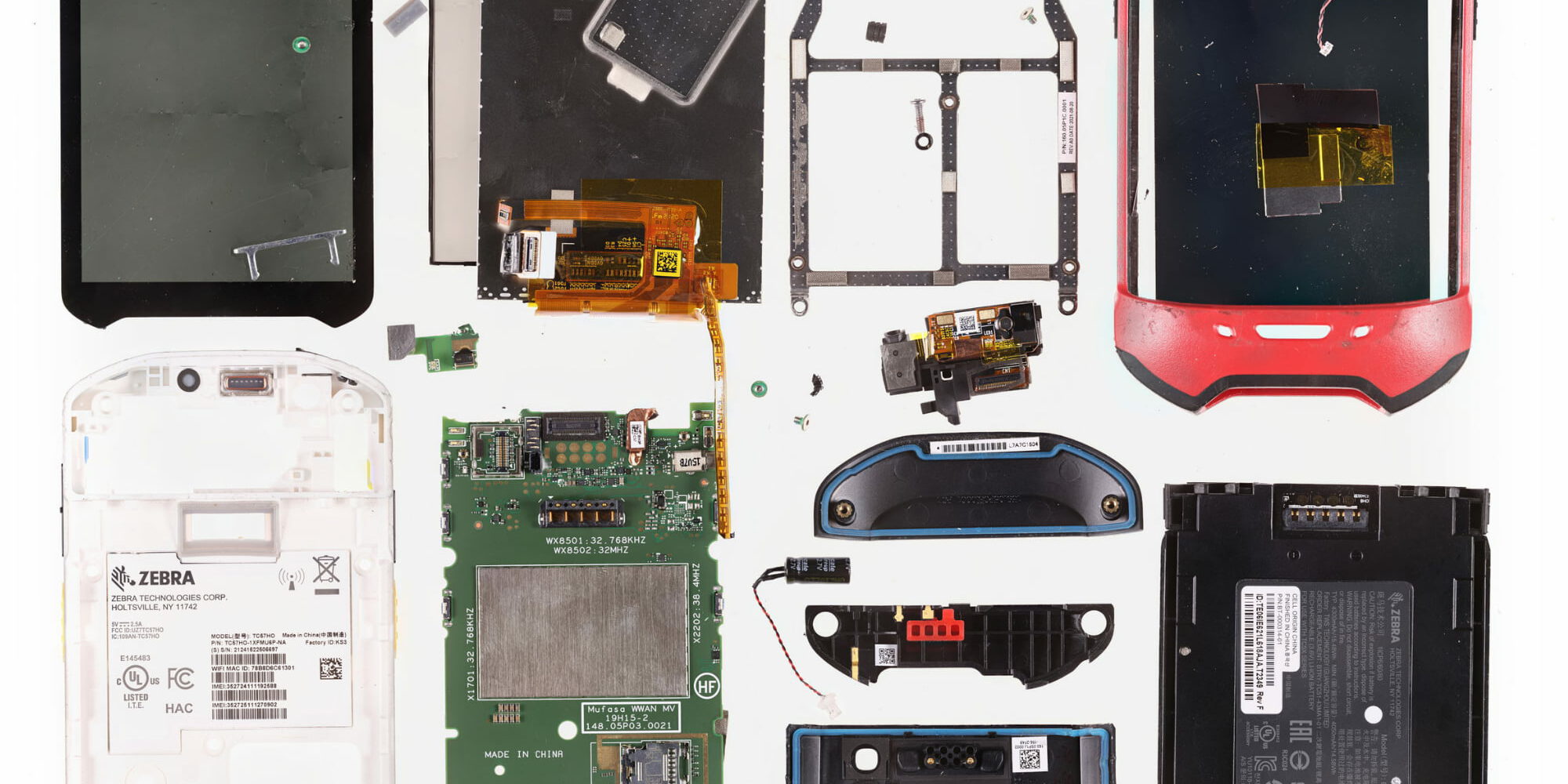
For most people, a smartphone is simply a tool they use every day. Beneath the display, however, lies a remarkably complex collection of processors, cameras, sensors, batteries, antennas and precision-engineered components working together in a space only a few millimetres thick. A new collection of sixteen teardown images opens that hidden world up to inspection.
Each teardown was captured on a GIGAmacro robotic imaging system and assembled from hundreds of individual high-resolution photographs — 5,041 across the collection, from 144 for the smallest subject to 560 for the largest. The results can be explored from a view of the whole device right down to microscopic detail: integrated circuits, flexible ribbon cables, camera modules, solder joints, connectors, and the individual red, green and blue subpixels that make up each display. The largest image in the set, the Zebra TC67HO, runs to 1.28 gigapixels; together the sixteen come to roughly 14.3 gigapixels.
A decade of mobile engineering
The collection covers roughly a decade of mobile hardware, with devices from Apple, Samsung, LG, Nokia, OnePlus, Zebra, Wiko, Sky Devices and Cloud Mobile — fifteen phones and one iPod. Side by side they trace the pace of change in the industry, from early touchscreen handsets with removable batteries to modern flagships with OLED displays, multiple camera systems and in-display fingerprint sensors.
Several devices mark real milestones. The iPhone 5s, introduced in 2013, was the first smartphone with a 64-bit processor and Apple’s Touch ID fingerprint authentication. The Samsung Galaxy A20 and OnePlus 7T show the move to AMOLED displays and increasingly sophisticated multi-camera systems. The Zebra TC67HO is a different animal altogether — enterprise hardware, with an integrated barcode scanner and the ruggedised construction that goes with it. Others reveal the modular, cost-driven construction typical of budget phones.
Comparing display technologies
One of the more rewarding things to do with the collection is to put the screens next to each other. At this resolution the microscopic architecture of each display is visible: traditional LCD panels against modern AMOLED, and the distinct subpixel arrangements that build every image the device has ever shown you.
The full collection
| Device | Photographs | Resolution |
|---|---|---|
| Zebra TC67HO | 560 | 1.28 GP |
| LG (K-Series / Aristo family) | 420 | 1.19 GP |
| Verizon Nokia | 385 | 1.18 GP |
| Samsung Galaxy A20 (A205U) | 350 | 1.07 GP |
| Cloud Mobile Stratus C5 Elite | 360 | 940 MP |
| Sprint Samsung Galaxy S | 378 | 933 MP |
| OnePlus 7T (HD190x series) | 300 | 918 MP |
| LG K10 (LGMS428) | 270 | 898 MP |
| Sky Platinum E5 | 315 | 873 MP |
| Wiko U307AS | 300 | 836 MP |
| iPhone 6s | 315 | 819 MP |
| LG LS660 | 240 | 790 MP |
| LG LGMS500 | 240 | 733 MP |
| iPhone 6s | 240 | 707 MP |
| iPhone 5s | 224 | 613 MP |
| iPod | 144 | 487 MP |
Why it matters
The collection works as a visual history of a familiar technology, but it is also a demonstration of what gigapixel imaging can do. Every connector, circuit trace, camera lens and display pixel can be explored interactively — familiar objects examined at a scale normally reserved for laboratory microscopes.
For engineers, students, educators, museum visitors and anyone with a curiosity about how things are made, it offers a perspective on one of the most influential technologies of the modern era: the phone in your pocket is also a remarkable piece of engineering.
Explore the Smartphone Teardowns collection →
About GIGAmacro
The smartphone teardown collection was created using a GIGAmacro® imaging system, which combines hundreds of precisely captured photographs into seamless gigapixel images. GIGAmacro systems are used worldwide by museums, universities, researchers, manufacturers and government agencies to document objects ranging from microscopic specimens to large artefacts, while preserving exceptional resolution and colour fidelity.
To learn more about GIGAmacro imaging systems or explore interactive gigapixel images, visit www.GIGAmacro.com or get in touch.
Gene is a creative innovator and developer with a passion for developing scientific tools, exhibits, and educational programs that provide new ways of exploring the world both literally and figuratively.
Photography is a common thread in his life and work, which has come a long way since childhood years experimenting with unique perspectives, angles, filters, and time-lapse exposures.
He founded GIGAmacro to build robotic devices capable of capturing gigapixel photographs with microscopic detail and developing new visualization tools for comparison of complex imagery for research, science, and education.